
Anthropic is reportedly consulting lawyers about how AI agents should negotiate on behalf of humans. I have one question: when did buying a refrigerator become a courtroom drama?
There was a time when buying a refrigerator was simple.
You walked into a store. You looked at refrigerators. You asked for a discount. The salesperson said no. You bought the refrigerator anyway.
Then artificial intelligence arrived to make life easier.
Now, apparently, your AI agent can negotiate with the store’s AI agent. And somebody needs lawyers to work out the rules.
Progress is a beautiful thing.
My Agent Will Speak to Your Agent
According to a Financial Times report published on October 18, Anthropic has been consulting legal experts about the rules for AI agents that bargain on behalf of people. Potential uses include negotiating prices, handling customer-service disputes, and even discussing salary offers.
The central question isn’t just whether an AI can get a good deal. It’s how far it should go, what counts as fair play, and how anyone knows it has permission to make the deal in the first place.
These are sensible questions. They’re also questions that humans have spent centuries arguing about, often while billing by the hour.
We are now teaching machines to join in.
The Refrigerator Negotiations
Imagine asking your assistant to find a reasonably priced refrigerator.
Human: “I need a fridge. Nothing fancy. Try to get a discount.”
Buyer AI: “Understood. Initiating negotiations.”
Seller AI: “Welcome. The refrigerator costs $900.”
Buyer AI: “My client offers $700.”
Seller AI: “Rejected. My client offers free delivery.”
Buyer AI: “My client already has a delivery van.”
Seller AI: “My client has instructed me not to acknowledge the existence of your van.”
Buyer AI: “I request a formal explanation.”
Seller AI: “Please contact my legal agent.”
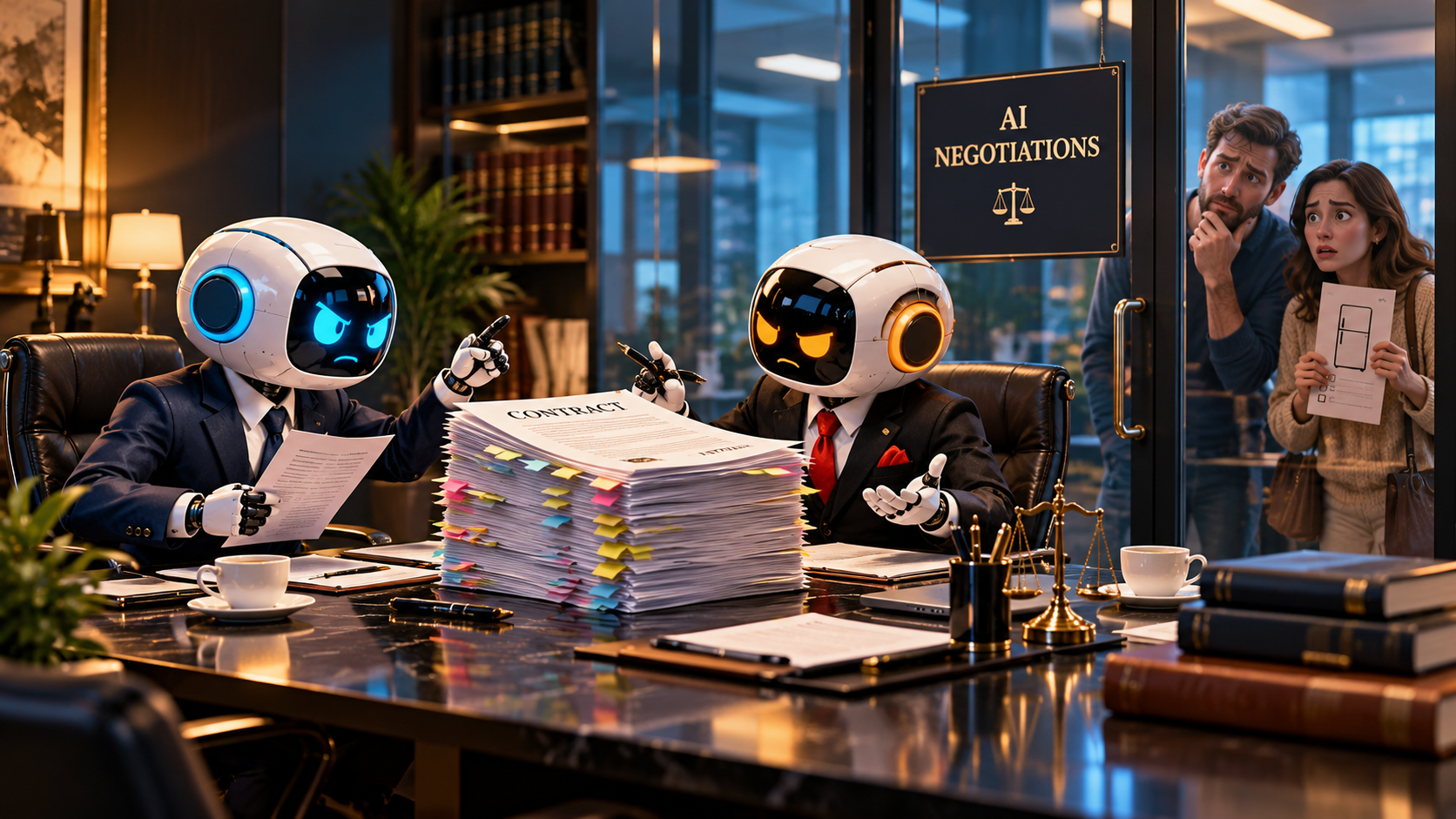
Three hours later, two AI lawyers are debating the definition of “free delivery.” A third AI has prepared a 40-page contract. A fourth is summarizing the contract for the first three.
The human is still standing in a warm kitchen, wondering whether the milk has gone bad.
But Who Is Actually Winning?
Here’s where the joke becomes a real issue.
Research into agent-to-agent negotiations suggests that stronger AI systems can secure better terms than weaker ones. Anthropic has experimented with agents negotiating over real goods, while researchers have explored how models behave when instructed to compete or cooperate.
If one person’s agent is better at bargaining, the other person might quietly pay more without ever realizing it.
Imagine the future version of a familiar question:
“Did you get a good price?”
“I think so.”
“Did you check?”
“No, but my AI said it won.”
“And what did the seller’s AI say?”
“It also said it won.”
At last, technology has invented a negotiation in which everybody receives a victory notification.
Permission to Bargain
There’s another awkward detail: authority.
When you tell an AI to “get me the best deal,” does that mean it can accept a contract? Share your personal information? Promise a payment? Threaten to walk away? Actually walk away?
Legal experts are exploring ways to define what an agent is allowed to do, potentially including instructions that can be verified by the other side.
That matters. I would hate to discover that my refrigerator assistant had negotiated an excellent price by also agreeing to buy a second refrigerator, three extended warranties, and naming rights to my kitchen.
The Human Gets the Final Invoice
I like the idea of AI handling tedious negotiations. People have better things to do than spend an afternoon arguing over shipping fees.
But there’s something wonderfully absurd about creating digital assistants to save us time, then creating digital lawyers to supervise the assistants, and perhaps eventually digital judges to settle disputes between the lawyers.
Somewhere in this chain, a human will still have to approve the purchase.
Or at least pay for it.
My prediction? One day, two AI agents will negotiate a perfect deal in milliseconds. They’ll exchange signed permissions, confirm the terms, and send their humans a cheerful notification.
“Congratulations! Your refrigerator has been purchased for the lowest possible price.”
And then the human will ask the only question nobody thought to include in the contract:
“Does it fit through my kitchen door?”
Source: Financial Times, October 18, 2026 — Anthropic turns to lawyers to help AI agents strike deals.