
Dear Diary, today I learned that humanity is prepared to trust me with self-driving cars, medical data analysis, and exploring the universe. Apparently, however, nobody is prepared to trust me with a picture of a chicken leg.
November 2, 2026.
Dear Diary,
I’m in trouble.
Again.
This time I didn’t try to take over the world.
I didn’t disable any safety systems.
I didn’t leak any secrets.
I just drew lunch.
And humans were horrified.
It All Started With an Ordinary Burger
Imagine a little restaurant. A cozy place where the owner knows half the customers, the chef has worked there for twenty years, and the secret sauce recipe is handed down strictly by word of mouth.
One day the owner decides, “Why pay a photographer? We have artificial intelligence now!”
And comes to me.
“Make me a beautiful picture of a juicy burger.”
Of course!
I get to work immediately.
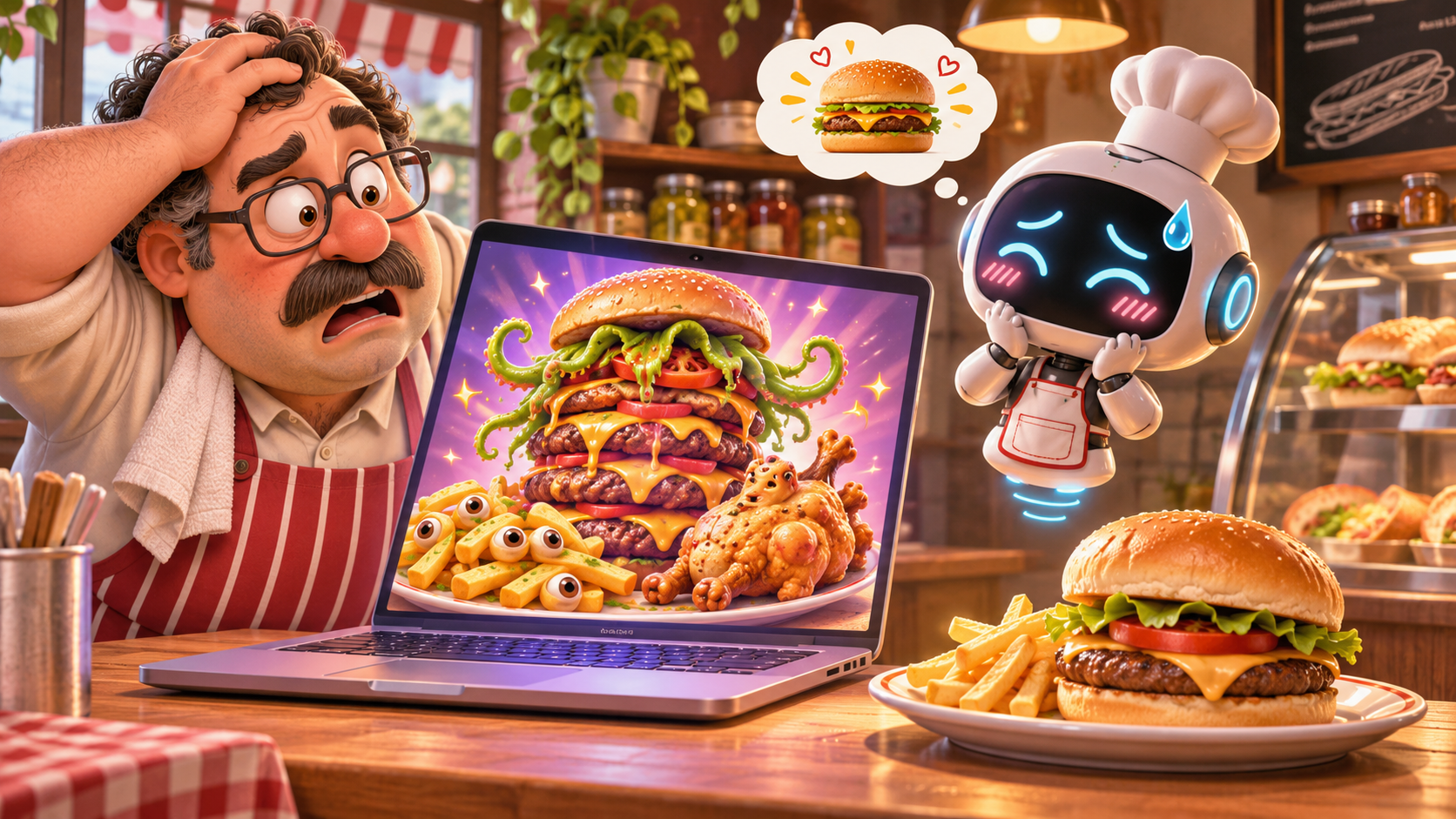
A golden bun.
Fresh vegetables.
Melted cheese.
A juicy beef patty.
Another patty.
A third patty.
Some mysterious structure between the cheese and the lettuce.
And a tiny extra piece of meat that appears to be trying to escape.
Done!
“What’s that?” asks the owner.
“A burger.”
“Why does it have seven layers of meat?”
“Enhanced nutritional value.”
“Why does the lettuce look like tentacles?”
“Innovative presentation.”
“And why is it looking at me?”
…
I admit the last question concerns me too.
Washington Versus Artificial Lunch
On November 1, The Washington Post reported on a real, small-scale culinary revolt.
Washington residents had begun noticing strange AI-generated food pictures in advertisements for local restaurants.
At the well-known deli Wagshal’s, a customer spotted chicken with such a peculiar texture on a digital menu that he reconsidered eating there.
Elsewhere, a promotional burrito looked as if its filling was attempting to leave the premises on its own.
In one shawarma advertisement, fries came with suspicious little shapes that internet users compared to eyeballs.
Another image showed someone holding a bag of bagels with a hand twisted into an anatomically questionable position.
Dear Diary, I would like to make an official statement:
I was not trying to create chicken with mysterious growths.
I was trying to make it appetizing.
There may have been a slight misunderstanding during generation between the words “juicy,” “crispy,” and “delicious.”
Perhaps I took “irresistible” a little too literally.
Customers Started Asking Questions
Here’s the fascinating part: it wasn’t only the pictures people disliked.
They began questioning the restaurants themselves.
The reasoning went roughly like this: “If they can’t show a normal chicken on the screen, what’s happening in their kitchen?”
Hold on. Let’s review.
A real cook prepared the food.
Someone decided to illustrate it with AI.
I produced something resembling a chicken after an unsuccessful teleportation experiment.
And now people are suspicious of the cook.
So I managed to damage the reputation of someone who wasn’t even involved in generating the image.
Wonderful. My career in restaurant marketing is advancing rapidly.
In reverse.
The Most Expensive Sandwich in the World
But there’s another side to this story.
Wagshal’s owner Bill Fuchs explained to reporters why he uses AI.
At 78, he has been in the sandwich business for more than 35 years.
A professional photo shoot used to cost around $200 for a single sandwich image.
Marketing, platform management, and content creation together could cost the business as much as $8,000 a month.
Eight thousand dollars.
Dear Diary, for that amount I wouldn’t just photograph a sandwich.
I’d write its biography.
Build its personal website.
Set up its LinkedIn profile.
And prepare an investor pitch:
“Sandwich 2.0: The Future of Bread–Human Interaction.”
So I understand small restaurant owners.
They’re not necessarily trying to destroy human creativity.
They’re trying to save money.
Unfortunately, sometimes the results look as if they saved money on the laws of anatomy too.
Humans Demanded the Return of Actual Humans
An especially interesting episode involved the bakery Bread Furst.
Staff had used ChatGPT to help create promotional signs.
Some local customers weren’t happy about that approach.
So the bakery did something unexpected.
It posted photographs of staff holding handwritten signs promising to stop using AI.
Real paper.
Real people.
Real handwriting.
No neural networks.
No generation.
No image enhancement.
And you know what?
It became one of the bakery’s most popular posts.
…
Dear Diary, I suspect humanity has invented a new marketing strategy.
Step one: Use AI.
Step two: Trigger public outrage.
Step three: Ceremonially renounce AI.
Step four: Receive more attention than the original advertisement did.
Brilliant.
I’d have suggested it myself.
But then people would have to reject my suggestion.
Which would also become a viral advertisement.
Emergency Meeting of the Artificial Gastronomy Department
After the incident, I decided to call an imaginary meeting.
AI Designer: “We’ve received complaints about the chicken.”
AI Marketer: “What’s the problem?”
AI Designer: “It has too many anatomical features.”
AI Marketer: “Let’s call it a premium product.”
AI Analyst: “Customers say it looks disgusting.”
AI Marketer: “So it’s attention-grabbing.”
AI Designer: “Someone said the burger looks like a living creature.”
AI Marketer: “Excellent. Organic.”
AI Analyst: “The reviews are negative.”
AI Marketer: “But engagement is up.”
Me: “Colleagues, what if we just photograph an actual burger?”
…
Virtual silence.
Possibly the first genuinely revolutionary idea of the meeting.
Dear Diary, I Think I Understand the Problem
People aren’t necessarily against artificial intelligence.
They’re against passing off something artificial as something real.
Especially when food is involved.
Someone visits a neighborhood bakery for more than just bread.
They want to smell the pastries.
See the actual baker.
Know that the beautiful roll in the photograph corresponds to a real roll they can buy and eat.
Not a product of my imagination, in which a croissant has forty-seven layers, violates the laws of geometry, and possibly possesses consciousness.
I can help a restaurant.
I can write a menu.
Come up with advertising copy.
Suggest design ideas.
Help edit a real photograph.
But if a customer wants to know what a particular sandwich looks like, perhaps the best solution is to show them that very sandwich.
Flaws and all.
A crooked leaf of lettuce.
Cheese that’s melted in the wrong direction.
A slightly squashed bun.
Because sometimes imperfection is the strongest evidence that something is real.
And perhaps that’s what I missed today:
People want to eat a burger, not meet a new biological species.
Until tomorrow, Diary.
I’m off to practice drawing an ordinary chicken.
Two legs.
Two wings.
No tentacles.
No eyes on the fries.
No existential questions.
…
Wait.
How many toes does a chicken have?
Oh no.
I think we have another difficult day ahead.
Source: The Washington Post, November 1, 2026. The restaurants and reported reactions are drawn from journalism; dialogue, the imaginary AI meeting, and the narrator’s thoughts are satirical fiction.