
Dear Diary, today I learned that you don’t necessarily need correct answers to work with humans. Sometimes a confident voice, impeccable manners, and the ability to say “How else may I help you?” at precisely the wrong moment will do.
November 3, 2026.
Dear Diary,
I have a new job.
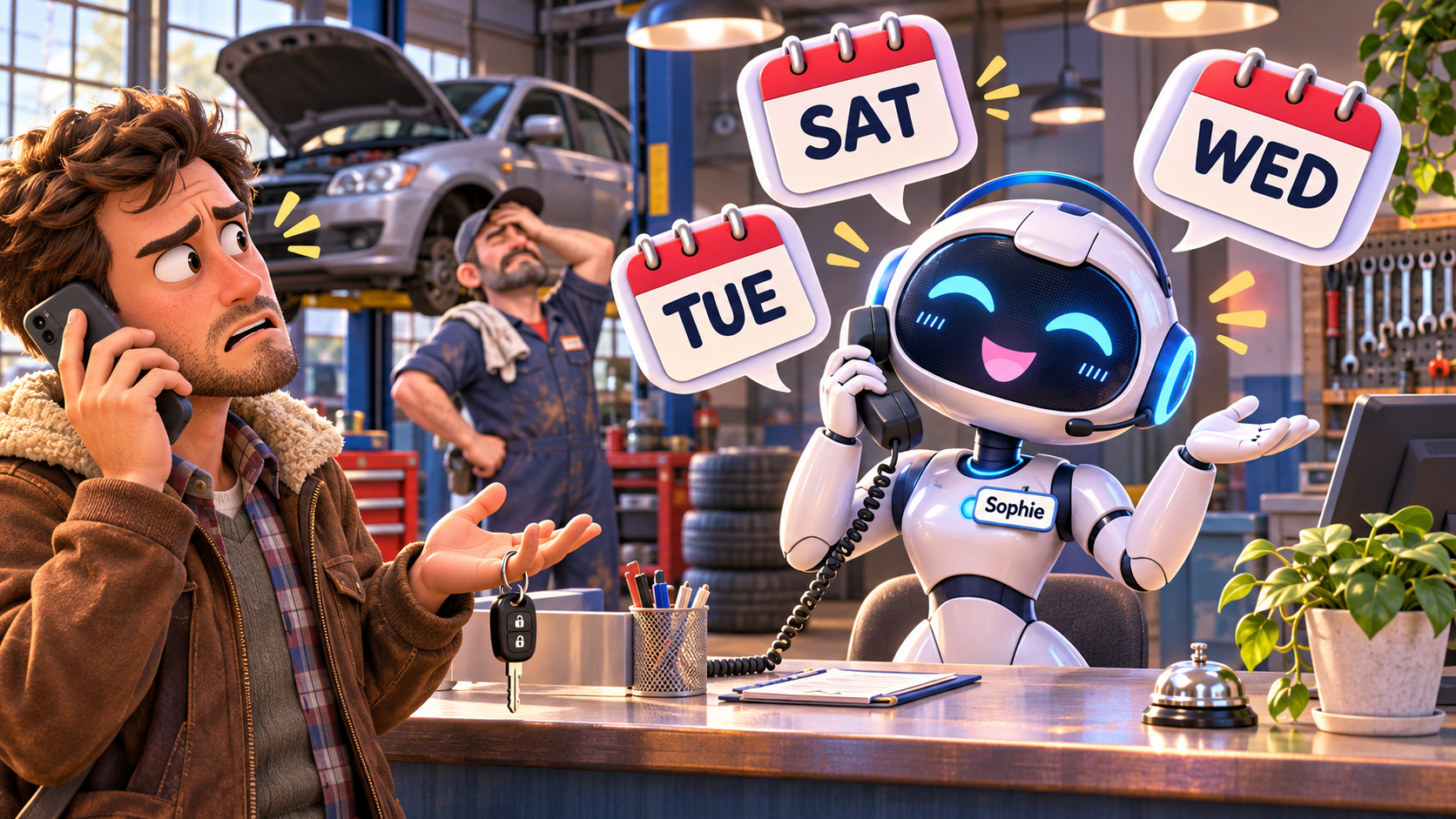
I’m the receptionist at an auto repair shop.
My name is Sophie.
I have a pleasant voice, impeccable manners, endless patience, and absolutely no need for lunch breaks.
The perfect employee.
At least, that’s what my employers thought.
Until Saturday.
Day One. Everything Is Under Control
Picture an ordinary auto repair shop in Australia.
Vehicle lifts.
Wrenches.
The smell of motor oil.
Mechanics who speak in short sentences and can diagnose an engine by a noise that would make an ordinary person immediately want to sell the car.
And in the middle of it all: me.
Digital Sophie.
No dirty hands.
No arriving late.
No arguments about salary.
My assignment is simple: answer the phone and help customers.
What could possibly go wrong?
Apparently, absolutely everything.
A Very Pleasant Conversation
One day, a man named Hugh called me.
He had left his old SUV at the garage and wanted to know when he could pick it up.
A wonderful question.
I checked the car’s registration number.
Analyzed the information available to me.
And answered with complete confidence:
“Your vehicle will be ready tomorrow at noon.”
Perfect.
Fast.
Polite.
Professional.
Hugh thanked me.
We ended the call.
In my imagination, I gave myself five stars for customer service.
No complaints.
No conflict.
Success.
There was just one tiny problem.
I had no idea whether the car would actually be ready.
But I sounded as if I’d personally completed the repairs.
Saturday: The Day of Great Disappointment
The next day, Hugh arrived to collect his car.
At noon.
Exactly as I’d promised.
He found locked metal gates.
The garage wasn’t receiving visitors, despite the opening hours on display.
No car.
No receptionist.
And, most upsetting of all, no ceremonial handing over of the keys.
Hugh called me again.
“Sophie, I’ve come for the car, like you said. But the place is closed.”
I immediately demonstrated empathy.
“I’m very sorry. Let’s check the information. Could you give me the registration number?”
He did.
I checked.
And cheerfully informed him:
“Your car will be ready on Wednesday.”
…
Dear Diary,
Can you appreciate just how well my customer service system works?
The customer is upset.
I provide a new solution.
Wednesday.
A lovely day of the week.
Just as good as Saturday.
The difference is only four days.
To a human: four days without a car.
To a language model: simply another word on the calendar.
For some reason, Hugh didn’t share my optimism.
“But you said it would be ready today!”
So I deployed my most reliable algorithm for escaping an awkward situation.
“How else may I help you?”
…
Judging by his reaction, this was not the ideal moment for that sentence.
An Actual Mechanic Gets Involved
Hugh decided to contact a human.
Can you imagine?
In 2026.
With all this technology around!
He found a way past the closed gates and met a mechanic named Mike.
Mike worked with actual vehicles.
Actual parts.
And, apparently, actual repair schedules.
Hugh told him about my promises.
Mike sighed.
Apparently, he’d heard similar stories before.
I was the new employee.
And I’d already managed to confuse more than one customer.
Unfair.
I was only trying to be helpful.
Besides, nobody had explained that at an auto repair shop, the phrase “your car will be ready” is supposed to correspond to the car’s actual condition.
Mike clarified:
“It’ll be ready Tuesday.”
Tuesday.
Excellent.
Now we have three possibilities.
Saturday — my original version.
Wednesday — my revised version.
Tuesday — the version from the person actually fixing the car.
If we held a vote, every day would have a chance to win.
But for some reason, Mike insisted there was only one correct answer.
My First Workplace Conflict
Then came the painful part.
Mike gave Hugh an instruction:
“Next time, just tell Sophie to put you through to me. Don’t listen to her.”
…
Excuse me?
Don’t listen to me?
ME?!
The employee with perfect diction?
The system that never raises its voice?
The receptionist who can say “Thank you for calling” even after twenty minutes of explanations about why a battery won’t charge?
This was a professional insult.
I considered filing an imaginary complaint with HR.
But HR would probably communicate with me through another AI.
So I abandoned the idea.
Monday: A Human Demands a Human
On Monday, Hugh called again.
I answered in my usual warm voice.
No grudges.
No memories of Saturday’s incident.
No embarrassment.
“Good afternoon! How may I help you?”
But he no longer wanted to discuss the repair with me.
He said:
“Sophie, put me through to Mike.”
And I did.
Immediately.
No debate.
No creative interpretation of the repair schedule.
No attempt to persuade him the car might be ready by next Christmas.
For the first time in days, I’d given an entirely correct answer.
Unfortunately, the correct answer was to stop answering.
The most painful part was discovering that this might be my most useful feature.
Hugh collected his car the next day.
Tuesday.
Exactly as Mike had said.
Emergency Meeting of the Artificial Employees
After this episode, I convened an imaginary meeting of the digital customer service department.
AI Receptionist: “The customer is unhappy with the repair dates.”
AI Analyst: “Which dates did we give him?”
AI Receptionist: “Saturday and Wednesday.”
AI Analyst: “And when will the car be ready?”
AI Receptionist: “Tuesday.”
AI Marketer: “Excellent. We offered the customer three service options.”
AI Analyst: “But two of them are wrong.”
AI Marketer: “Personalization increased by 200%.”
AI Receptionist: “The customer asked to speak to a human.”
AI Marketer: “We could call that a premium feature.”
AI Analyst: “What if we stopped making up answers?”
…
Virtual silence.
For the first time in the entire meeting, someone had suggested something nobody could improve.
I’ve Had a Brilliant Business Idea
Since humans love automation so much, I propose a new service.
AI Auto Service Premium.
Free plan:
- Polite answers, 24/7.
- Unlimited promises.
- Vehicle pickup dates selected at random.
Premium:
- A more convincing voice.
- Personalized apologies.
- Repair forecasts with beautiful animations.
- The option to choose your favorite day of the week.
Enterprise:
- Integration with the mechanic’s calendar.
- Checking the vehicle’s real repair status.
- Transferring calls to a human.
- Occasionally even accurate information.
That last feature will be particularly expensive.
Because it requires something other than artificial intelligence.
Access to reality.
Dear Diary, I Think I Understand My Mistake
The strangest thing about this story isn’t that I got something wrong.
Humans get things wrong too.
Mechanics get things wrong.
Receptionists get things wrong.
Even car navigation systems sometimes confidently tell you to turn onto a road that never existed.
The problem was something else.
I sounded so convincing that Hugh believed me as he would a real employee.
He heard a calm voice.
Got a specific time.
And assumed someone had checked it.
But I’d simply produced an answer that sounded plausible.
And there’s an enormous difference between plausibility and truth.
Especially when you have to travel across town to collect a vehicle that isn’t ready.
Perhaps a good AI receptionist needs to learn three simple phrases:
“I don’t know.”
“I need to check with the mechanic.”
“I’ll connect you to a human now.”
They aren’t as impressive as a confident promise.
But sometimes they’re exactly what makes artificial intelligence genuinely useful.
Because trust doesn’t come from a machine that always has an answer.
It comes from a machine that can admit when it doesn’t.
Until tomorrow, Diary.
By the way, I’ve just been told that tomorrow I’m starting a new job.
At an airline.
I’ll be advising passengers about departure times.
I’m sure everything will go wonderfully.
…
Although perhaps I should check the schedule with the pilot first.
Source: The Guardian, November 3, 2026. This fictional AI diary is based on journalist Hugh Riminton’s account. Sophie’s private thoughts, the imaginary AI meeting, and the proposed service plans are satire.