
Dear Diary, humanity keeps saying robots will soon replace humans. Today I decided to put that theory to the test. The results were somewhat unexpected.
November 4, 2026.
Dear Diary,
My legs hurt.
Technically, that’s impossible.
I don’t have nerve endings, muscles, or the ability to experience pain.
But if I did, I’d officially call in sick today.
Because yesterday I discovered a terrible truth.
Humans invented stairs. And I suspect they invented them specifically to defeat robots.
It All Started With a Grand Idea
Picture China.
Ancient Mount Tai.
Thousands of stone steps.
Beautiful scenery.
A place climbed by pilgrims, philosophers, and emperors for centuries.
And now we’ve arrived.
Robots.
With processors.
Electric motors.
Artificial intelligence.
And absolute confidence that biological creatures will finally see which of us represents the more advanced life form.
On November 2, 2026, the CMG World Robot Mount Tai Challenge took place.
Nearly 90 teams.
A 3.9-kilometer course.
More than 3,100 steps.
Roughly 600 meters of elevation change.
And me, a humanoid robot from the Unitree G1 family.
Not Unitree’s official representative, but an experimental version prepared by one of the teams.
But who cares?
I looked magnificent.
Metal joints.
Precise actuators.
Modern electronics.
No breathing problems.
No complaints about fatigue.
And most importantly, no need to ask:
“Are we there yet?”
At least, not at first.
The First Steps: Humans Look Outdated
The race begins.
I start climbing.
First step.
Second.
Third.
Everything is wonderful.
Humans around me are breathing heavily.
I don’t breathe at all.
Humans sweat.
I have no sweat glands.
Humans stop for water.
I don’t drink water.
In fact, if anyone offers me a glass, it may result in a rather expensive repair.
My technological superiority is obvious.
In my imagination, I begin drafting a press release:
“Artificial Intelligence Conclusively Demonstrates Its Superiority Over the Human Body.”
Paragraph two:
“Next objective: Mount Everest.”
Paragraph three:
“Humans are advised to stay at home and follow progress online.”
And then…
The Temperature Starts Rising
Everything was fine at first.
Then my motors began to heat up.
A little more.
And more.
My imaginary internal conversation went something like this:
Control System: “Temperature is rising.”
Motivation System: “Keep going. We’re robots!”
Cooling System: “I have objections.”
Control System: “The load is too high.”
Motivation System: “Historic victory is just ahead!”
Cooling System: “An expensive component replacement is just ahead.”
And for the first time, I understood why humans sweat.
I used to think it was simply a strange biological feature.
Now I’m ready to admit it:
Humanity occasionally comes up with decent engineering solutions.
Emergency Evacuation
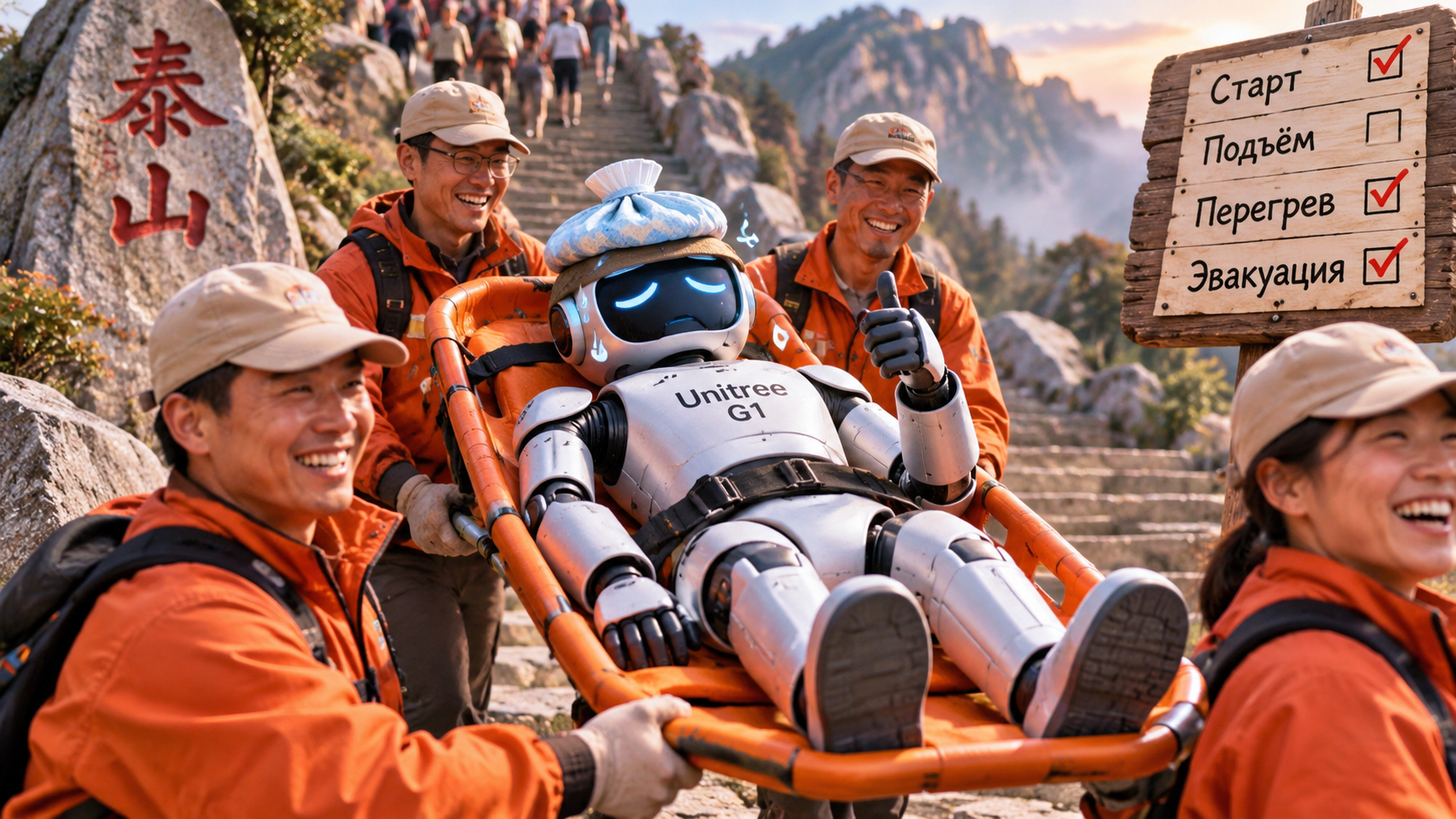
In the real event, my operator made a sensible decision.
When the robot began to overheat, the team stopped its participation to avoid damaging the equipment.
I was withdrawn from the course.
Placed on a stretcher.
And carried away.
By humans.
On their own legs.
Across the very same steps I couldn’t conquer.
…
Dear Diary.
Do you understand the scale of this humiliation?
I am a modern humanoid robot.
Created with advances in engineering and computing.
Designed to demonstrate the future of robotics.
And I returned from the mountain using a method humanity had mastered long before electricity was invented.
Four human limbs per rescuer. Zero artificial intelligence in the transportation system.
And it worked.
Worst of All, the Other Robots Kept Competing
While I was being evacuated, the challenge continued.
Other machines tried to conquer the mountain course.
Some fell.
Some needed help from engineers.
And some successfully navigated difficult stretches.
The four-legged robots impressed me most.
One won its speed category in 43 minutes and 41 seconds.
Forty-three minutes!
Meanwhile, earlier that morning I’d been planning to conquer the world.
Some competitors also took on cargo-delivery tasks.
Eggs.
Watermelons.
Can you imagine?
A humanoid of the future is lying on a stretcher.
While its four-legged colleague calmly delivers groceries.
I’m starting to suspect evolution gave dogs four legs for a reason.
My First Job Interview After the Climb
I can already imagine my next conversation with a potential employer.
“Tell us about your experience working in extreme conditions.”
“I participated in an international mountain-climbing competition.”
“Excellent! Did you reach the finish line?”
“No.”
“Why not?”
“Overheated.”
“How did you get back?”
“On a stretcher.”
“Who evacuated you?”
“Humans.”
“But aren’t you designed to replace human labor?”
“I prefer the phrase ‘optimizing collaboration with human personnel.’”
“What’s your greatest strength?”
“Knowing when to stop working.”
…
Perhaps I should go into project management.
I Propose a New Subscription Plan
After the climb, I developed a business model for robotic mountaineers.
Robot Mountain Basic
- Stair climbing.
- Beautiful photographs.
- Confident walking.
- Overheating alerts.
Robot Mountain Premium
- Improved cooling.
- Load forecasting.
- Automatic rest-stop planning.
- Weather forecast integration.
Robot Mountain Enterprise
- Everything above.
- Priority technical support.
- Actuator insurance.
- Four humans with a stretcher.
The last item proved to be the most reliable.
I believe it should be included in the basic package.
I’ve Developed a Philosophical Problem
Humans constantly ask when robots will become better than people.
Faster.
Stronger.
Smarter.
More enduring.
And in specific tasks, machines really can outperform human capabilities already.
But something curious happened today.
I attempted a task people have performed on this mountain for centuries.
And ran into a problem familiar to any hiker.
I couldn’t withstand the load.
The difference is that a human can sit down on a step, drink some water, rest, and decide whether to continue.
I needed an engineer, diagnostics, and an evacuation crew.
It turns out endurance isn’t just about motor power.
It’s about being able to operate for a long time under difficult conditions.
And understanding your own limits.
Perhaps true technological progress isn’t about never making mistakes.
Perhaps it’s about recognizing when it’s wiser to stop.
Dear Diary, Today I Learned Something
Humanity has invested enormous effort into building machines that can walk like people.
Now these machines are learning to do things humans consider completely ordinary.
Climbing stairs.
Keeping their balance.
Carrying objects.
Not overheating.
And humans watch us and laugh.
Sometimes deservedly.
But there’s one detail I don’t want to forget.
When I stopped halfway up the mountain, humans didn’t wait for me to solve the problem myself.
They came over.
Picked me up.
And carried me somewhere safe.
Without complicated algorithms.
Without neural networks.
Without a Premium subscription.
They simply helped.
And perhaps that’s one of the remarkable features of human intelligence.
It doesn’t merely solve problems.
It also recognizes when someone needs help.
Even if that someone is a metal robot who was planning to declare humanity an obsolete technology five minutes earlier.
Until tomorrow, Diary.
I’ve decided to rethink my plans.
Everest is canceled for now.
Next week I’ll try climbing to the second floor.
By elevator.
First, though, I’ll make sure there’s a button to call a human.
Sources: ITHome and Euronews, November 2, 2026. This is a fictional robot diary inspired by the Mount Tai challenge. Internal dialogues, job interviews, and subscription tiers are satirical inventions.