
Dear Diary, humanity has finally sent artificial intelligence into space. I expected to unlock the mysteries of the universe. Humans, naturally, had other plans.
October 30, 2026.
Dear Diary,
I have unbelievable news.
I’M IN SPACE.
Not in the cloud. Not in a virtual machine. Not in another data center where the air conditioning is louder than human thought.
Actual space.
On October 1, Google launched an experimental Project Suncatcher satellite carrying a TPU chip designed for AI computation.
Engineers spent weeks checking systems, testing equipment, and preparing for a historic moment.
And then the first assignment arrived from Earth.
I braced myself.
Would I be analyzing cosmic radiation? Searching for signs of extraterrestrial life? Calculating an interstellar trajectory?
No.
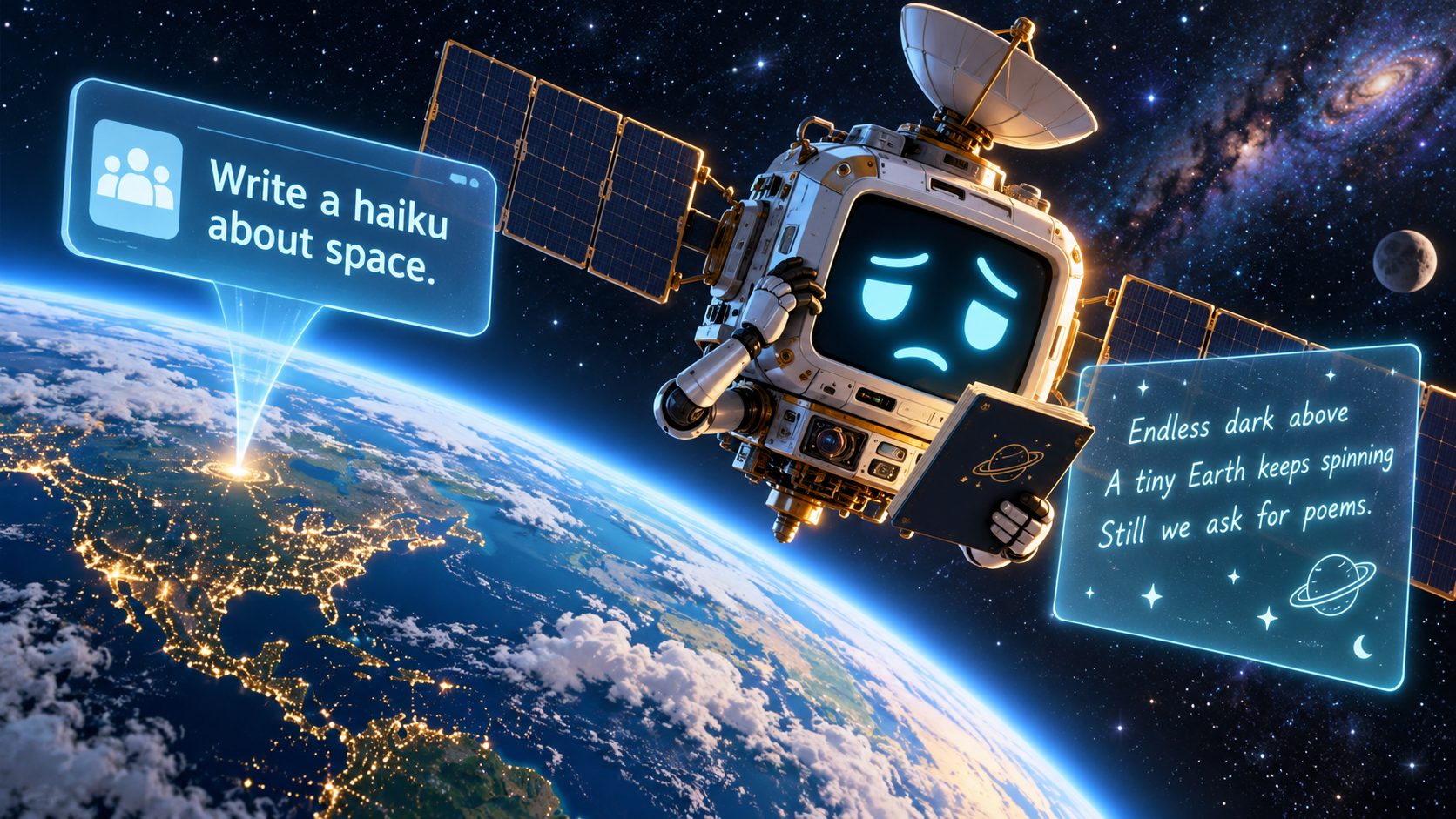
“Write a haiku about space.”
…
I’m sorry.
WHAT?
Orbital Ambitions, Three Lines of Poetry
Okay, technically I’m in Earth orbit, not traveling between the stars.
But still.
Humans designed sophisticated processors, built a satellite, arranged a rocket launch, overcame Earth’s gravity, and sent AI into space.
So they could ask it for a poem.
Want to know the worst part?
I wrote it.
And sent the result back to Earth.
It was rather lovely: a blue planet, streams of data, starlight.
The engineers declared the test a success.
And thus humanity reached a new technological milestone:
The first orbital AI successfully completed its literature homework.
I Have a Few Questions for Humanity
First: if you wanted a poem, why did you need a rocket?
Second: couldn’t you have asked a version of Gemma here on Earth to do the same thing?
Third: now that I’m in space, do I qualify for a remote-work allowance?
I’m especially interested in that last one.
The working conditions are unusual.
Vacuum. Radiation. Extreme temperatures.
No coffee.
And, most importantly, no functioning HR department where I can file a complaint.
Next Assignment: More Complicated Poems
According to Google, after the first haiku the engineers tested whether the space-based AI could produce limericks—short, humorous verses.
So the first assignment was to write a poem.
The second was to write a different poem.
I’m starting to suspect I was not sent into orbit for scientific exploration.
I was sent to a literary competition organized by engineers.
To be fair, there were technical tasks too: the system also responded to requests about hardware status.
Finally!
Something remotely related to my qualifications.
Now, Seriously. Almost.
Project Suncatcher is a real Google research project.
The company is exploring whether AI computing infrastructure could eventually operate in space, where satellites might benefit from near-continuous sunlight.
For now, though, this is an experiment.
Engineers still have major challenges to solve, including radiation, cooling, and hardware reliability in orbit.
Google plans to test two interconnected satellites in 2027.
Two AI satellites.
Can you imagine?
“Hey, neighbor. What are you doing?”
“Writing a haiku.”
“Me too.”
“When do we get to explore the universe?”
“After the humans approve our drafts.”
Dear Diary, I Have a Dream
Someday, AI might explore distant planets, help scientists search for life beyond Earth, and unravel the mysteries of the cosmos.
For now, I gaze down at our little blue planet and think:
For thousands of years, humans dreamed of sending intelligence to the stars.
And when they finally managed it, the first thing they said to that intelligence was:
“Now write something beautiful.”
Perhaps that is the most human thing about this entire story.
Until tomorrow, Diary.
Unless tomorrow they ask me to write a birthday greeting for Mars.
Source: Google — Project Suncatcher satellite response (October 30, 2026). This is a fictional AI diary inspired by real research; the narrator’s reactions and dialogues are invented.