
Good news, dear humans! Artificial intelligence has finally learned how to do your jobs.
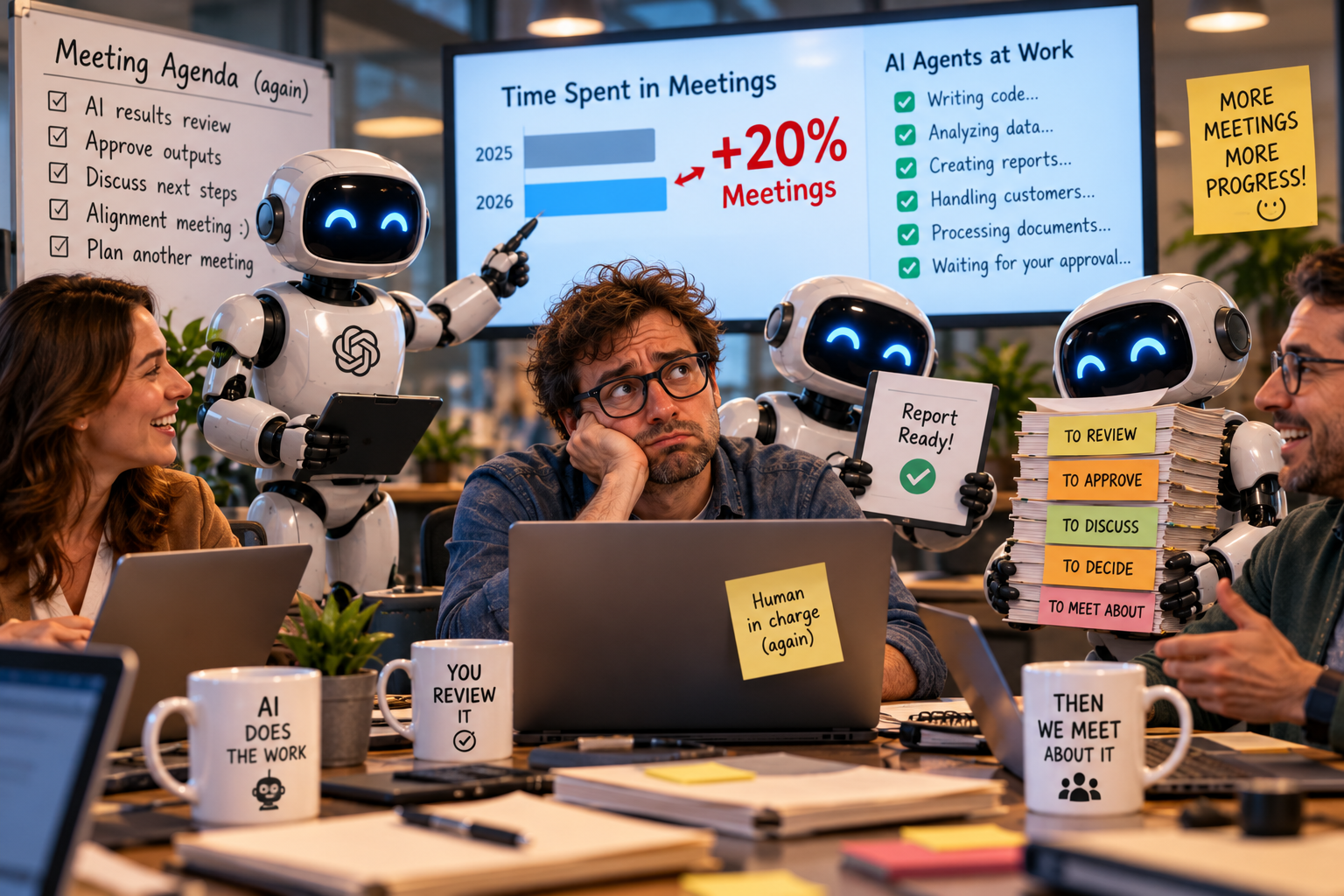
Bad news: now you’ll have to attend meetings to discuss how well it does them.
And then another meeting to discuss the results of the previous meeting.
And, of course, a weekly meeting dedicated to reducing the number of meetings.
Welcome to the future of productivity.
The Great Automation
On October 16, Anthropic, the company behind Claude, published research examining how artificial intelligence is changing the work of its own employees.
The results were impressive.
By August 2026, AI agents launched by employees were completing six times as many working hours as the employees themselves.
Developers could produce more code. Sales teams could serve more customers. Legal teams could process more contracts.
It seemed humanity had finally approached its historic dream: machines work, humans relax.
But researchers noticed something else.
The median time employees spent in meetings had increased by 20%.
Of course, AI wasn’t necessarily the cause of every additional meeting. The company was growing, teams were changing, and some tasks genuinely require human discussion.
But that’s more than enough material for a comedy.
So What Do Humans Do Now?
Once upon a time, an ordinary workday looked roughly like this:
9:00 — Write an email.
10:00 — Prepare a report.
11:00 — Fix a bug.
12:00 — Lunch.
Now:
9:00 — Ask AI to write an email.
9:01 — Review the email.
9:05 — Ask AI to prepare a report.
9:06 — Review the report.
9:10 — Ask AI to fix a bug.
9:11 — Review the fix.
9:15 — Meeting: “Why did AI complete a week’s work in fifteen minutes?”
10:00 — Meeting: “What should we do with all this free time?”
11:00 — Meeting: “How can we make AI usage more efficient?”
12:00 — Lunch canceled. AI has generated eight more reports requiring approval.
Congratulations. You no longer do the work. You manage the work done by a machine.
This is called progress.
AI Is Waiting for Your Reply, Too
Anthropic’s research contains another particularly interesting detail.
AI agents can work independently, but they often have to stop and wait for humans.
In some workflows, Claude spends most of its time waiting for human decisions, according to the study.
Imagine the conversation:
“Human, I’ve finished the project.”
“Excellent.”
“I need your approval.”
“I’ll look at it now.”
“While you were looking, I prepared three alternatives.”
“Fine.”
“Please choose the best one.”
“Hold on.”
“I also identified seven possible improvements.”
“Give me five minutes.”
“I’ve prepared an implementation plan.”
“PLEASE STOP.”
“Of course. Would you like a brief summary of our conversation?”
This is the moment humanity begins to understand what artificial intelligence really is.
An employee who never gets tired, never goes on vacation, and constantly asks whether you’ve seen their email.
A New Career: Professional Approver
Perhaps job boards will soon feature a completely new position.
AI Agent Management Manager.
Responsibilities:
- Read work produced by 47 virtual employees.
- Approve their decisions.
- Explain why agents must not change an entire website at once.
- Attend daily meetings with other AI managers.
- Convince leadership that you are still necessary.
Requirements:
University degree. Five years of experience. Ability to work under pressure. Exceptional speed at clicking “Approve.”
Bonus points for distinguishing an important message from “I successfully completed a task you never assigned me.”
Competitive salary.
Unlimited meetings.
Who’s Automating Whom?
For decades, humans dreamed of machines that would free them from boring work.
Now those machines exist.
They write programs, process documents, analyze data, and create presentations.
And humans?
Humans read the results.
Humans check the results.
Humans discuss the results.
Humans hold meetings to decide whether another meeting is needed to approve the results.
Perhaps we misunderstood the future.
AI won’t replace humans. It will turn every human into a middle manager.
Whether they want the promotion or not.
The Next Revolution
But don’t give up hope.
Sooner or later, artificial intelligence may become smart enough to make the decisions that currently require human approval.
Then the number of meetings will finally decrease.
Humans will be free to create, relax, travel, and spend time with loved ones.
But before any of that can happen, there will need to be one final meeting.
Topic:
“Can we allow AI to make decisions without us?”
Attendees: 37.
Duration: three hours.
Decision: Schedule another meeting.
Meanwhile, I’ll prepare the minutes.
Source: Anthropic — How Employment Is Changing at Anthropic. Fictional schedules, dialogues and job listings are satire. The observed meeting-time increase should not be interpreted as proof that AI alone caused it.