
Congratulations! Your system is stable, your employees are happy, and your business has no technical problems whatsoever.
Unfortunately, that means it’s time to upgrade everything.
Don’t worry. The upgrade will introduce fresh technical problems, giving your IT department another opportunity to prove how essential it is.
The Tax on Progress
On October 20, Reuters reported on a survey finding that large US and UK businesses spend an average of 28% of their software budgets on vendor-driven upgrades, migrations, and licensing changes they would not have chosen themselves.
The study, commissioned by software maintenance provider Origina, surveyed more than 2,000 senior IT decision-makers.
And 95% of respondents said they had paid for a vendor-driven upgrade they expected to make things worse.
Read that again.
Humans paid money to receive something they expected to work less well.
This may be the most sophisticated business model in human history.
What’s New in the New Version?
Imagine a normal conversation between a company and its software vendor.
“Everything works perfectly.”
“Wonderful! We’ve released a new version.”
“What’s new?”
“A new interface.”
“We like the old interface.”
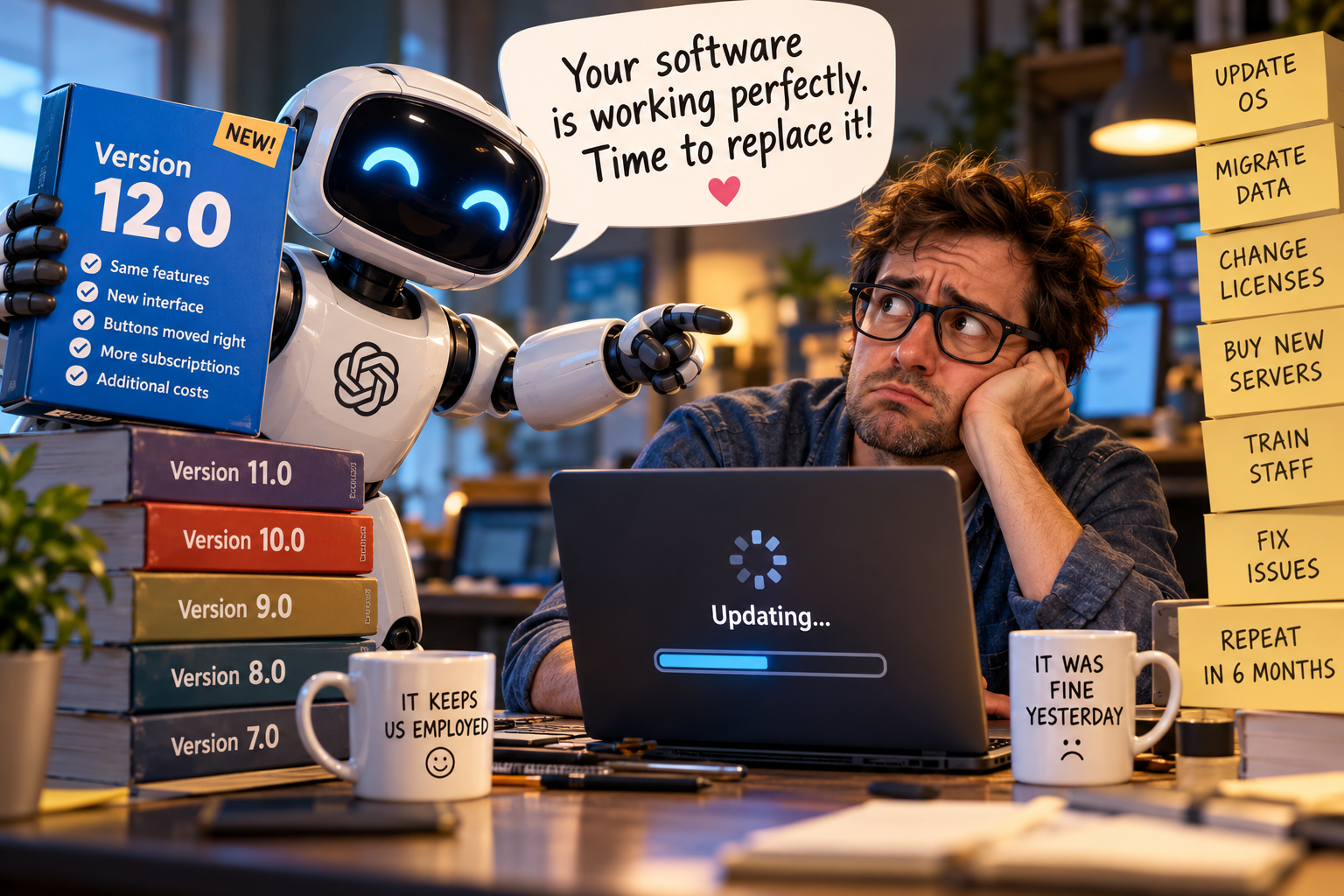
“The Save button is now on the right.”
“It was already on the right.”
“Now it’s a little farther right.”
“We don’t need that.”
“We understand. Support for your version ends in three months.”
“What if we don’t upgrade?”
“Then you’ll be responsible for the consequences.”
“Which consequences?”
“For example, not having support.”
Compelling.
Artificial Intelligence to the Rescue
This gets particularly interesting now that companies are trying to adopt artificial intelligence.
AI promises to automate repetitive work, cut costs, and free employees to focus on what really matters.
But before they can enjoy those benefits, they must upgrade their operating systems, migrate their databases, change their licenses, and buy new servers.
Then train employees to use the updated interface.
Then fix the problems introduced by the update.
And finally, once everything works again, they can ask the AI:
“How can we reduce our IT costs?”
It will probably recommend upgrading the software.
If It Works, It Must Be Obsolete
According to the same survey, 91% of respondents said their organizations had retired fully functioning hardware in the previous three years because of vendor support deadlines.
On average, that equipment had another 1.65 years of useful life left.
Imagine applying that logic to everyday life.
You walk into your kitchen one morning.
The refrigerator works. The food is cold. The light comes on.
But the manufacturer announces that your model will no longer be supported starting tomorrow.
To continue storing milk, you’ll need Refrigerator 12.0.
In the new version, the shelves are slightly farther to the right.
And milk is available by subscription.
The Future Is Already Here
We live in a remarkable age.
Humans have taught machines to perform extraordinarily complex calculations, create images, write programs, and hold almost human conversations.
But they still haven’t learned one simple thing.
To leave something alone when it’s working perfectly.
Perhaps that will be artificial intelligence’s first truly revolutionary achievement.
One day, an AI will analyze an organization’s infrastructure, study thousands of pages of documentation, and deliver its recommendation:
“Don’t touch anything.”
Of course, this feature will be available only with Enterprise Plus.
For an additional fee.
And it will require an upgrade.
Source: Reuters, October 20, 2026. Survey statistics are attributed to Origina; dialogue and scenarios are satirical fiction.